

Many growing brands struggle with brand awareness. It can feel expensive, confusing and slow to build. But awareness does not have to be complicated. At its core, it is about becoming front of mind for people who are willing and ready to buy in your category.
Awareness has long been linked to penetration and market share growth. Below we explore why it matters, what fuels it and what growing brands need to focus on.
Competition Is High and Mindshare Is Limited
It has never been easier to create a new brand. With endless options available, buyers have limited mental availability. If you want to grow, you need to win consideration at the right moment.
Differentiation is key to becoming memorable. Simple, consistent and ownable brand assets build distinctiveness over time. These can include a logo, colour, tagline, packaging or a style of execution. When used consistently, they form memory structures that make your brand easier to recall when a category decision is made.
Coca-Cola demonstrates this perfectly. For more than a century the brand has invested in distinctive assets. In 1915 they briefed manufacturers to create a bottle that could be recognised by touch alone. This long-term focus has helped Coca-Cola become the default mental shortcut when people think about soft drinks.
Winning Brands Have Broad Reach
Young brands often market in bursts to narrow segments, pausing to rebuild budgets before advertising again. This limits growth. Successful brands build broad reach and consistent messaging that speaks to larger audiences.
Consumers are increasingly fickle. A more effective growth strategy is to fill the top of the funnel by driving penetration rather than focusing only on loyalty or frequency among existing users.
Advertising bursts can create temporary spikes, but without consistency they do not sustain growth. Always-on communication, paired with distinctiveness, builds awareness and secures mental availability at the point of purchase.
Dove is a strong example. Their use of colour, talent, typography and composition is so consistent that their creative is recognisable even without the logo.
The Reality of Awareness and Growth
Awareness takes time. There are no shortcuts. Great brands invest up front to build assets they can own and repeat. Those assets then work harder for them over the long term.
Distinctive assets combined with broad reach and consistent frequency help a proposition take root in people’s minds.
So Why Does Brand Awareness Drive Growth?
- Competition is intense: Use distinctive visual and verbal cues to stand apart and earn memory.
- Mindshare is limited: People consider a small number of brands. Break into their consideration set with clarity and relevance.
- Penetration beats loyalty: Growth comes from new buyers. Reach widely and communicate consistently to attract them.
How This Shows Up in the Traction Framework
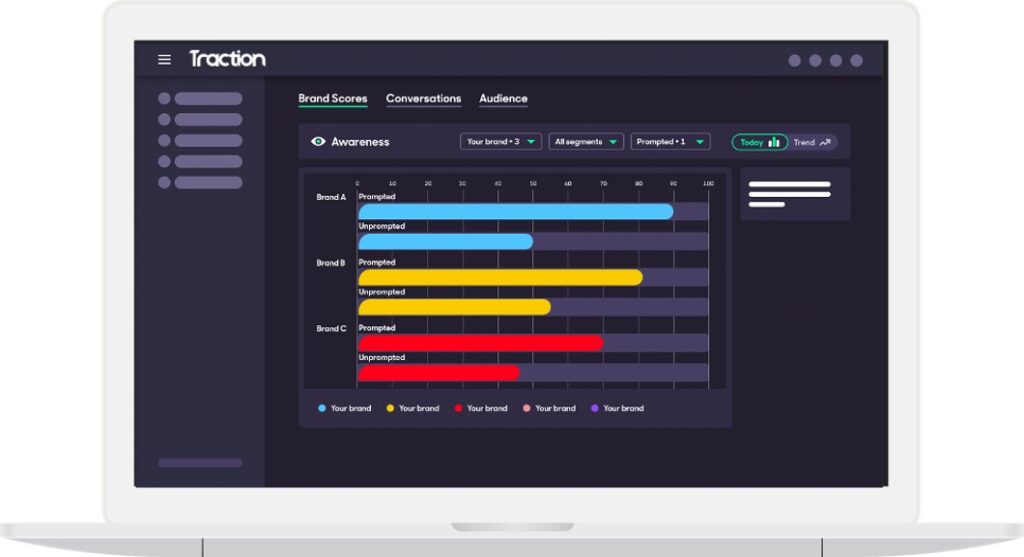
Brand awareness is not a standalone metric. Through the Traction framework, it is best understood as the outcome of several Drivers working together to earn mental availability at the moment of choice.
Differentiation sits at the centre. Distinctive assets, from visual identity to tone of voice, help brands stand apart in crowded categories. When a brand is easy to recognise and clearly different, it becomes easier for consumers to recall and consider, especially under time pressure.
Clarity plays an equally important role. Awareness without understanding rarely drives growth. Brands that clearly communicate what they stand for, who they are for and why they exist are more likely to enter a consumer’s consideration set. When a brand’s role is ambiguous, awareness alone is not enough to convert attention into choice.
Consistency reinforces both Drivers over time. Repeated exposure to the same distinctive cues builds memory structures that strengthen recall. This is why always-on communication outperforms short bursts. It is not frequency alone that matters, but the consistency of what people see and experience.
Finally, Relevance determines whether awareness translates into penetration. Brands must not only be remembered, but remembered for something that matters. When a brand aligns with current needs, context and expectations, awareness becomes commercially meaningful rather than superficial.
Together, these Drivers explain why brand awareness remains one of the strongest predictors of long-term growth. It is not about being seen everywhere, but about being remembered clearly, consistently and for the right reasons.
This is exactly why Traction focuses on understanding how brands perform across these Drivers continuously, not just through topline awareness metrics.
Start Monitoring Your Awareness
Tracking brand awareness helps you understand how people perceive your brand versus competitors and which factors influence recall. With our platforms always-on visibility you can see whether your brand is becoming more distinct, more attractive or more understood over time.