
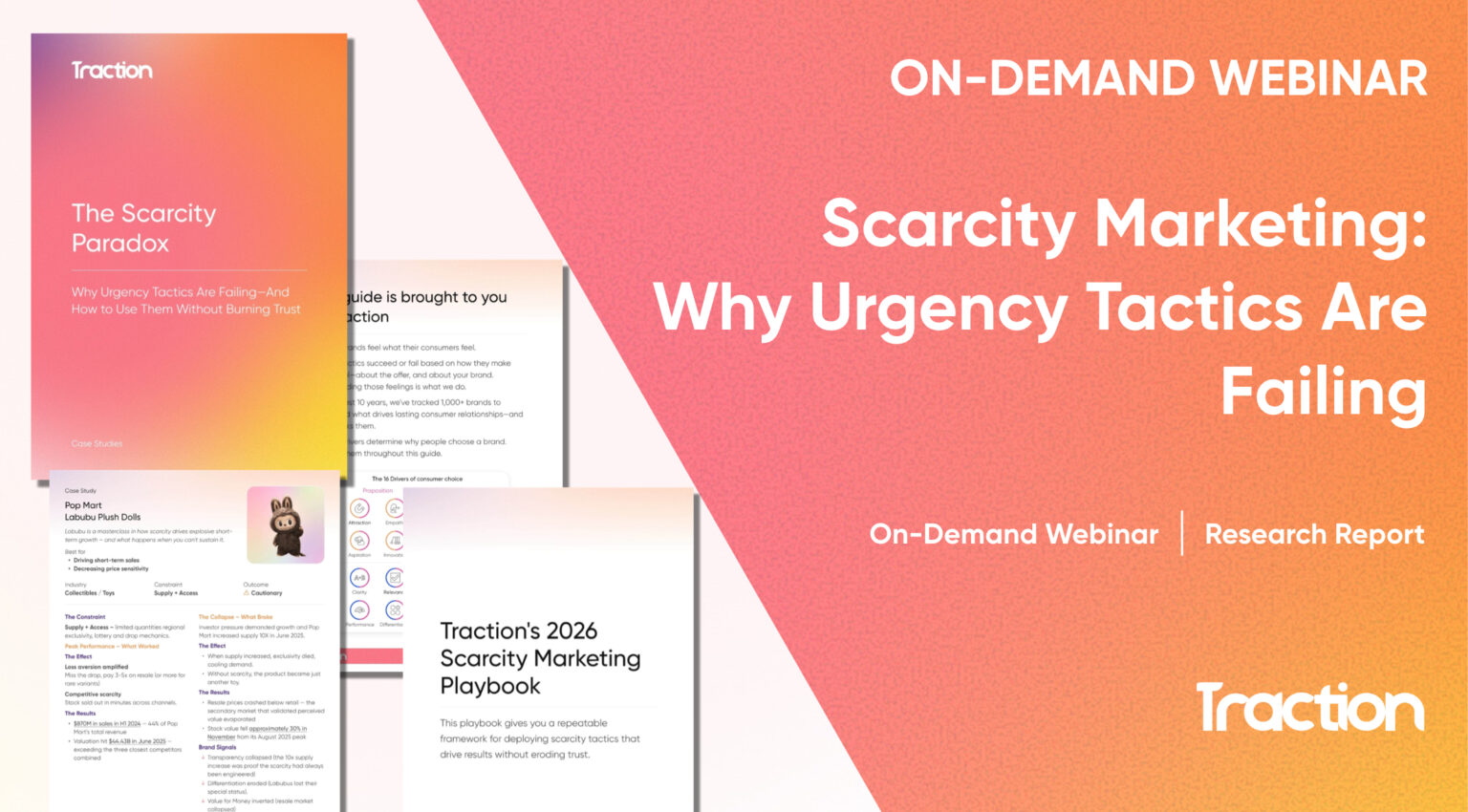
On-demand webinar & research report
Scarcity Marketing: Why Urgency Tactics Are Failing
Scarcity marketing still works. It just does not work the way it did five years ago. Countdown timers, limited drops and low-stock flags are producing diminishing returns across retail, and they now carry regulatory risk alongside the reputational kind. Watch the full session, and read the research behind it.
What you get
- The full 37-minute session, on demand, with jump links to every section.
- The Scarcity Paradox — 23 pages, six brands, three head-to-head match-ups.
- A four-step playbook for pressure-testing a constraint before you build a campaign on it.
Get instant access
Fill this in and the recording and the report open straight away. No waiting, no sales call.
Who you will hear from
Three of us, across the hour.

Jamie Law
Marketing Lead
Hosts. Opens the session and closes it out.

Abbie Mackie
Research Manager
Walks through all six brands and what separated each pair.

Tyson McKeown
CEO
On spotting the damage while a campaign is still running, rather than afterwards.
Six brands, three head-to-head match-ups
Each pair ran the same tactic, at the same sort of scale, in the same era. The only thing left to explain the gap is execution.
Match-up 1
SKIMS v Kylie Cosmetics
Same product-drop mechanic. One still has 14% of customers buying 15 months on. The other lost 58% of e-commerce revenue.
Match-up 2
Nike SNKRS v Pop Mart
Same limited-supply play. One kept the limit meaningful. The other flooded the market and watched resale fall below retail.
Match-up 3
Starbucks v Ticketmaster
Same seasonal scarcity. One published the rules up front. The other let customers find them at checkout.
The three traps
Every campaign that failed in this research fell into at least one of them.
- The overuse trapThe more often you deploy urgency, the less urgent each instance feels. You stop accelerating decisions and start training customers to wait.
- The value halo trapScarcity makes a product feel better as well as more wanted. That perception is borrowed. Increase supply and the sense of value goes with it.
- The hidden rules trapCustomers forgive scarcity. They do not forgive rules they discover at checkout. Price tiers, fees and limits belong in the announcement.
Questions people ask
When do I get access?
Immediately. Fill in the form above and the recording and the report open on the next page.
How long is the webinar?
Thirty-seven minutes including the questions at the end. The page has jump links for every section, so you can go straight to the part you need.
Who is it for?
People who own brand or campaign decisions at consumer brands: heads of brand, marketing directors, insight and consumer intelligence leads, and ecommerce or trading teams planning scarcity into a promotional calendar.
Is this a product demo?
No. Around five minutes covers how Traction measures the Drivers discussed. The rest is the research and what to do with it.
Why scarcity marketing is getting harder
Three things have changed at once, and they compound.
Frequency. Black Friday, Singles Day and Prime Day all followed the same trajectory: a window that began as a day and stretched into a season. Prime Day alone went from 24 hours to 96, and spend per hour fell by around 15%. When every week carries a deadline, no single deadline moves anyone.
Literacy. Shoppers have learned to read the signals. A low-stock flag that never runs out, a countdown that resets on refresh, a “was” price nobody ever paid — these are recognised now, and the suspicion does not stay contained. It carries across to everything else the brand says.
Enforcement. Urgency cues have moved from a marketing question to a compliance one. In November 2026, Canada’s Competition Bureau obtained a court order compelling Gap Inc. to produce records on how Old Navy and Gap use countdown timers, low-stock messaging and regular-price claims. No finding has been made. But the direction of travel is clear enough: if a constraint is not real, someone can now ask you to prove it was.
None of this makes scarcity marketing a bad tactic. It makes the gap between a real constraint and a manufactured one worth far more than it used to be, and that gap is what this session is about.
About Traction
Traction is an always-on brand tracking platform for consumer brands. We have tracked more than 1,000 brands over the last decade to understand what builds lasting consumer relationships, and what quietly spends them.
Our framework measures 16 Emotional and Rational Drivers of consumer choice in real time, so a shift in how people feel about your brand shows up while there is still time to act on it, rather than in a quarterly report three months later. That is the difference between scarcity marketing that builds equity and scarcity marketing that burns it. You can see how the platform works, or talk to us.
Get the recording and the report
One form, and both open straight away. The report goes public on 27 November.