

Social Listening has become a popular way for marketers to monitor online conversation, but it’s often positioned as an easy fix for a much more complex problem. The reality is that Social Listening struggles to provide the depth or accuracy needed to understand consumers or drive meaningful brand decisions, highlighting the limitations of social listening.

Why Social Listening Falls Short
There are several structural challenges that make Social Listening difficult to rely on as a primary source of consumer insight:
- Social platforms are noisy and overcrowded, making it hard to isolate meaningful signals
- Sentiment is difficult to interpret accurately at scale
- Conversation is shifting from public spaces into private messaging
- Data is often unstructured and difficult to action
The Core Limitations of Social Listening
The quality of the data
Social Listening tools can generate enormous volumes of surface-level data. Sifting through this can be both time-consuming and frustrating. For instance, searching for conversation related to a brand like Apple requires filtering out endless irrelevant mentions about the fruit before identifying anything meaningful about the company.
Representativeness is also an issue. Social platforms attract specific audiences, so insights are skewed toward the views of the most vocal users rather than the most valuable consumers. This limits the value of the insight for marketers who need a reliable view of the full category.
On top of that, Social Listening reflects what people are willing to say publicly. That doesn’t always align with true sentiment or behaviour. Trolls, performative posting and curated identities distort sentiment, and tools cannot distinguish between authentic opinion and online theatrics.
Social platforms are noisy places
Because Social Listening tools don’t allow you to set strategic objectives for data retrieval, the result is often a large amount of unstructured information with no clear connection to the business problem you’re trying to solve. For example, if you wanted to improve customer service, you’d still receive a broad sweep of general conversation rather than focused signals tied to the service experience.
Tools struggle to identify sentiment
Machines struggle to detect sentiment accurately, especially when sarcasm, irony or humor is involved. This leads to misclassification, where positive statements may be logged as negative and vice versa. For example, a phrase like “this product is the dog’s balls” would likely be interpreted literally, without consideration of cultural context or tone.
Conversation is moving out of public view
Public status updates, open discussions and comment threads have been replaced by private messaging on platforms like Instagram, WhatsApp and Snapchat. These environments are inaccessible to Social Listening tools, meaning an increasing portion of relevant conversation simply isn’t visible.
Insights are difficult to action
Even when meaningful observations do surface, Social Listening tools rarely provide guidance on what to do with the information. Marketing teams are left to create their own reports, charts and analysis to extract value, which slows down decision-making.
So What Should Brands Use Instead?
At Traction, our always-on Brand Management platform provides high-quality, action-oriented data designed to help brands grow. Unlike Social Listening tools, Traction measures how people think and feel about brands in real time across demographics, categories and usage groups.
How Traction Differs
We use Representative Data
Traction captures thoughts and feelings from real people every day, across all age groups, life stages and regions. This ensures a genuinely representative view of the market rather than the limited slice found on social platforms.
This also enables meaningful segmentation. Brands can compare users vs. non-users, explore different demographics and isolate how specific audiences perceive their brand.
We Show How Feelings and Thoughts Actually Matter
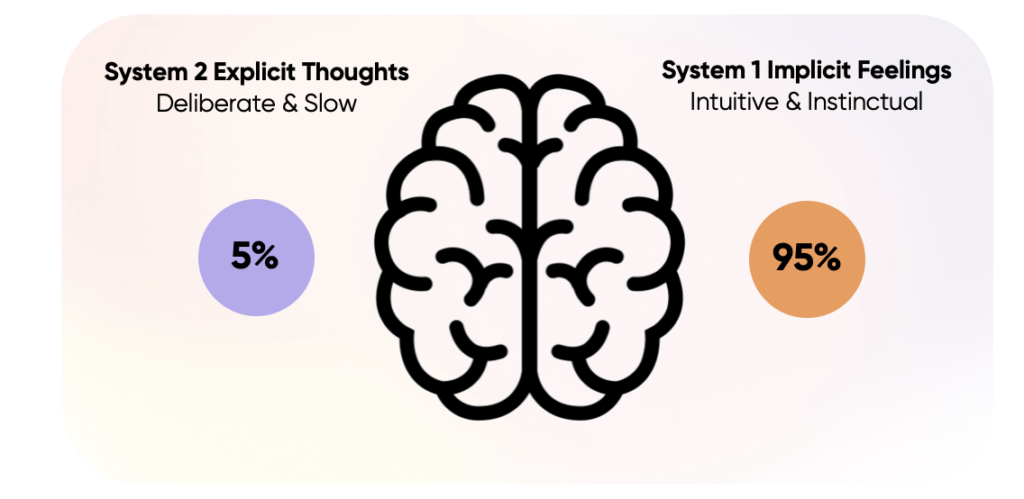
Ninety-five percent of purchasing decisions are driven by feelings. Social platforms rarely reveal these genuine emotional responses. On Twitter, people often highlight negatives to elicit brand replies or discounts, while Instagram and Facebook reward polished, curated identities. With so much self-presentation at play, true sentiment rarely surfaces.
How Traction Helps Brands Take Action
Traction doesn’t just track how people feel – it tells brands what to do about it. Marketers can set goals inside the platform and receive recommended actions based on real-time data.
Here’s how it works:
- You set business or marketing goals in the platform
- The platform collects real-time thoughts and feelings from consumers
- These inputs are mapped against the 16 Drivers of brand relationships
- The platform recommends specific marketing actions that will improve performance
The 16 Drivers represent the factors that shape how people feel about brands. When brands perform strongly against these Drivers, they improve their relationship with consumers and increase their potential for growth.
Traction also explains the ‘why’ behind consumer sentiment through Marketing Levers — practical actions marketers can take to improve specific Drivers. For example, a low score on Integrity may suggest packaging materials need to be more sustainable to align with consumer expectations.
A Better Alternative to Static Dashboards
Forget spreadsheets and endless reporting. Traction does the heavy lifting for you. You set the goal, the platform recommends the actions, and the brand improves based on what consumers actually think and feel.
How This Shows Up in the Traction Framework
The limitations of Social Listening become clearer when viewed through the Traction framework, particularly when it comes to understanding how brand relationships are actually formed.
Social Listening struggles most with Empathy. Public conversation rarely reflects how people truly feel. What consumers post is often performative, exaggerated or shaped by platform norms rather than genuine emotion. Without access to real feelings, brands risk mistaking noise for insight and reacting to the loudest voices instead of the most meaningful signals.
Clarity is another key Driver impacted by Social Listening. Unstructured, unfocused data makes it difficult for teams to understand what matters most or why. When insight lacks direction, it slows decision-making and creates uncertainty rather than confidence.
The shift toward private conversation also weakens Relevance. As cultural context and consumer expectations evolve, brands need timely understanding of what is changing and how it affects behaviour. Tools that rely on shrinking pools of public data struggle to keep pace with this reality.
Finally, Performance is where many Social Listening approaches fall down. Insight only creates value when it leads to action. Without guidance on what to do next, teams are left interpreting data in isolation, delaying impact and reducing commercial effectiveness.
Taken together, these Drivers highlight why modern brand insight needs to go beyond observation and into decision support. Understanding how people think and feel is only useful if it helps brands act with confidence.
This is exactly why Traction focuses on understanding how brands perform across these Drivers continuously, not just at isolated moments.
Your Next Step
Before Traction, Brand Managers relied on fragmented data and gut feel, with no clear way to measure the impact of their decisions. Now, they can make confident choices every day using richer insight than ever without scraping social feeds for sentiment.
Everything you need to grow your brand lives in one place.